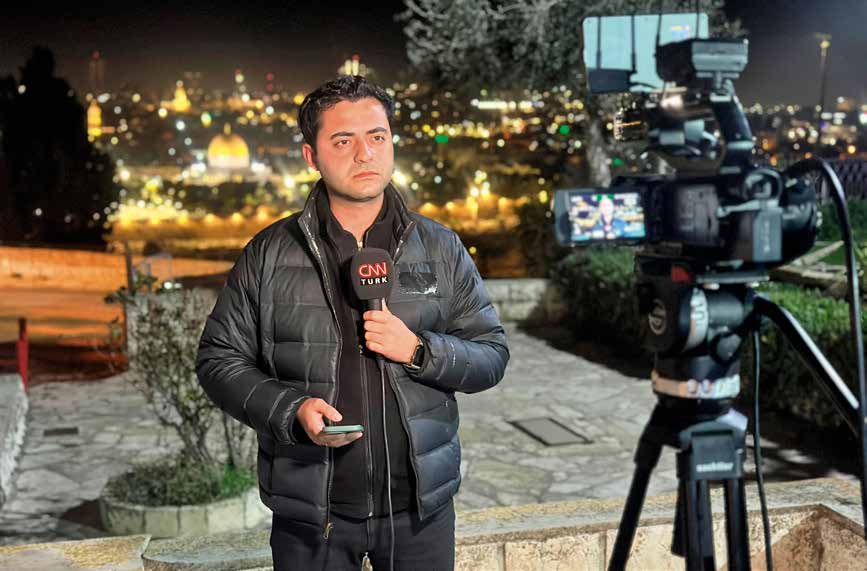

You’re undertaking a challenging task, and you’ve been here for quite some time. My initial question is: Can you depict the atrocities committed by Israel within Israeli territory and the areas under their control?
We’ve now surpassed forty days. Here, with each passing hour, they persistently make the work of journalists, particularly Turkish journalists, more arduous. There’s significant pressure on the Turkish press, and occasionally, even when we’re broadcasting in front of the hotel, we’ve witnessed police coming to check passports. Our duties extend beyond Jerusalem; we cover the Gaza border, Tel Aviv, and the West Bank. Thus, we continue to visit and observe every location. It’s evident that all eyes are on us wherever we go. In summary, there’s an attempt to psychologically intimidate us, and it’s amidst such intimidation that we strive to report everything we witness to the world. This isn’t my first time in this region, but it’s one of the most challenging in terms of coverage and live broadcasts.
Have you ever broadcast in the presence of so many armed individuals, especially in a region touted as peaceful?
I’ve never conducted a live broadcast in a place with such a high concentration of armed individuals. In fact, I’ve never even strolled through an area with so many armed civilians. When you’re in Tel Aviv and sitting at a café, you might see someone carrying an automatic gun passing by. Or suddenly, a civilian with two guns strapped to their waist might walk past you on the escalator in the shopping mall. These sights truly alarmed us, and we couldn’t shake off the unease whenever we traversed the streets. It’s quite peculiar; as we walk down a street, it immediately becomes apparent that we’re Turkish for some reason. My cameraman friend Halil and I were genuinely taken aback by this. For instance, when we’re seated at a café, after placing our order, we’re often asked, “Are you Turkish?” Even though we’ve ordered in English, it’s as if we have “We are Turks” written on our foreheads. As we roam the streets, the presence of armed civilians and police officers only heightens our anxiety because what they might do next is simply unpredictable.
Did you face any pressure from those civilians?
Yes, there is a hill in Sderot where all the Turkish press is stationed. From there, we observe the Gaza border. We faced threats there, and many Turkish journalists were also targeted with armed threats. They would come every day to film us and make statements like, “We have our eyes on you.” This happened every single day. I’m certain that most journalists experienced these threats, especially during the first 30 to 40 days. We, too, encountered threats from these civilians while on Sderot Hill, near the border.
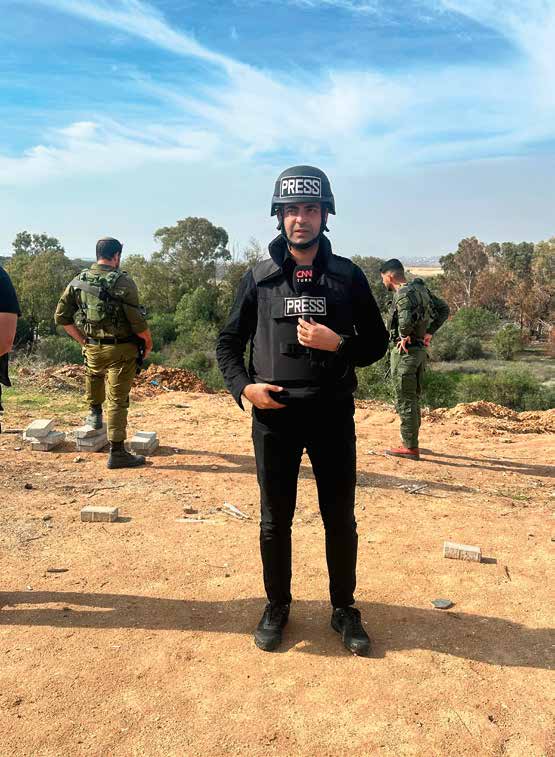
During this time, have you experienced an event that made you feel like quitting this profession or seeking psychological support?
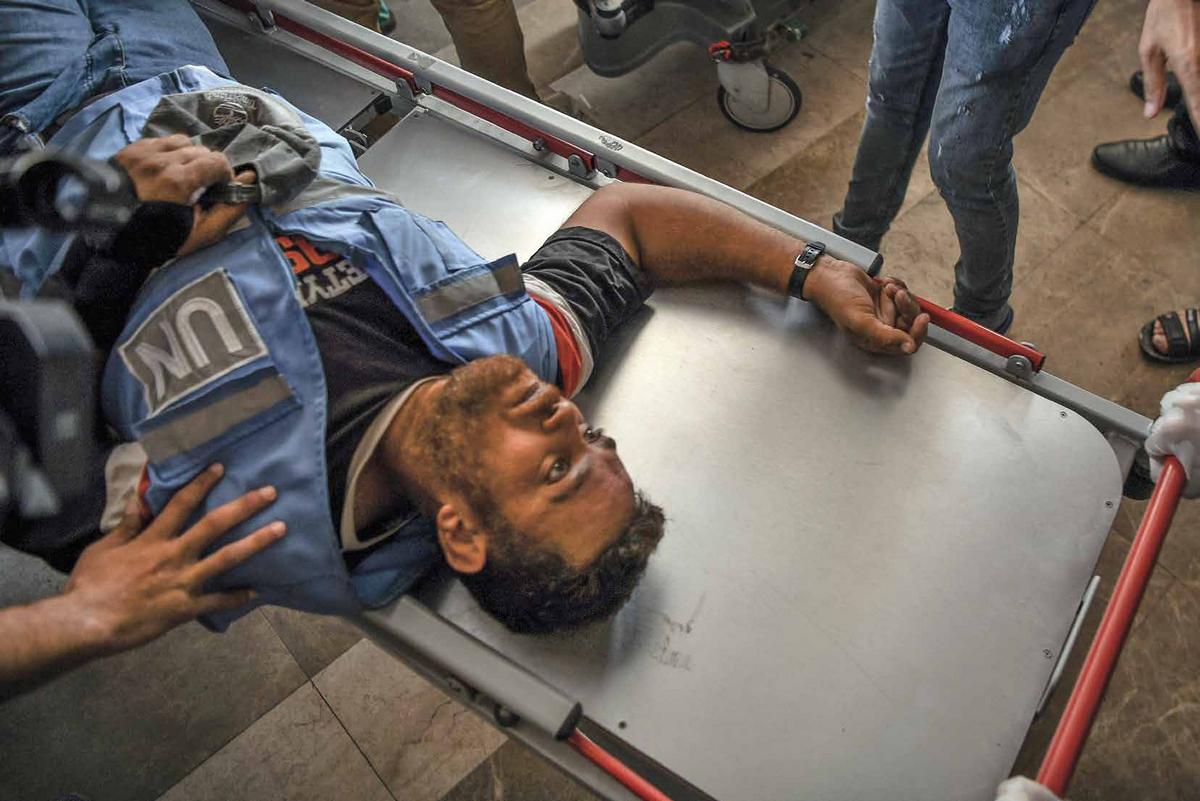
There was a truly terrifying moment. It was the day when Anadolu Ajansı’s cameraman (Mustafa Alkharouf) was brutally beaten on the ground in Jerusalem on a Friday. I was live with Halil, capturing those images. Throughout the live broadcast, I kept telling myself, “Stay calm. Describe what you see because it will be a testimony to the world. Don’t let your emotions take over. Just narrate what you see as calmly as possible.” That day was one of the few instances in my professional life when I was truly terrified because we couldn’t do anything to intervene or save our colleague who was being ruthlessly attacked on the ground. The violence didn’t stop at punches; he was repeatedly struck in the head with a gun and trampled underfoot. I will never forget those images. Typically, in my professional life, such moments would overwhelm me with emotions, making it impossible to remain composed, but during that live broadcast, I tried to maintain the utmost professionalism. Therefore, it was the most horrifying event for me.
What was it like to witness what happened during this time?
Look, Journalists from Europe, the Americas, and Asia flocked here, but let me summarize. Turkish reporters, cameramen, and journalists truly exemplified journalism to the world. Why do I say so? Because our gaze was fixed on both Tel Aviv and Gaza. We reported what happened in Sderot just as we reported what happened in Jerusalem. That’s why all Turkish journalists here, all journalists from Türkiye, really gave the world a lesson in journalism. This is truly a remarkable event that should be noted.
Even as we speak, armed guards pass right behind us
On my first day here, a Friday --perhaps the seventh or eighth Friday-- I was shocked. Police officers with automatic weapons stood at every street corner. They would grab us by the collar as we walked past; they shouldered us. We were unable to fully appreciate what was happening anyway... But now, they’ve turned it into a spectacle—a calculated display of intimidation. We set out from this very street. In the Muslim quarters, they lie in wait, fully armed. Their movements resemble a meticulously planned operation, executed with awareness of our cameras. It’s akin to a terrorist operation. Strangely, we’ve grown accustomed to it. The initial nervousness has faded. Conversations with them no longer unnerve me as they once did.